
How much does it cost to make an app? Anywhere from free on an AI app builder to $300,000 or more for a complex custom build, and enterprise apps can pass $2 million. App development cost depends on which of the four options you choose: building in-house, outsourcing it, building it with an AI app builder, or converting your existing web app. Building means hiring iOS and Android developers. The US median salary for a software developer was $135,980 in May 2025 (BLS). Agencies charge project fees instead, from $5,000 for a simple app to $300,000 or more for a complex one. Converting with Median is free to start, and then costs $229 or $7,200 a year for fully managed business services. The higher cost comes after launch. Apple and Google update their requirements every year and someone has to keep up.
App development cost breakdown
Here's how the cost to build an app compares across the main options, from what you pay upfront, to how long it takes and who maintains it.
Build in-house | Outsource to an agency | Convert your web app | |
Upfront cost | Developer salaries (US median $135,980 a year each), plus recruiting, hardware, and test devices | Project fee, from $5,000 for a simple app to $300,000+ for a complex one | Median self-serve from $229, managed from $7,200 a year |
Time to launch | Months | Months, depending on the agency | Days to weeks. Doctena had a first version in days, and Schedulefly and Conrad Siegel were live in two weeks. |
Who maintains it | Your mobile team | The agency, under a new contract | Your web team updates the web app, and Median keeps the native layer current |
Codebases to maintain | Web, plus iOS and Android | Web, plus whatever the agency builds | One, your web app |
Best for | Apps built around heavy on-device processing, like 3D games | One-off projects with no internal team | Teams with a working web app who want it in the app stores |
How much does it cost to build an app in-house?
Building in-house gives you the most control, but it’s also the most expensive way to build an app.
Most of the cost is people. A native app usually means separate iOS and Android codebases, so in-house mobile app development often means hiring for both platforms, and you keep paying those salaries for as long as the app exists.
Developer salaries – The US median for a software developer was $135,980 in May 2025 (BLS). Two platforms usually means two hires.
Recruiting – Hiring a developer can cost $5,475 to $35,879 once you add up recruiters, job ads, and interview time, and depending on the seniority level (SHRM).
Hardware and software – Development machines, licenses, and tools, roughly $4,500 to $7,000 to start.
Test devices – A spread of iPhones and Android phones to test on, roughly $2,000 to $5,000.
Internal time – Planning, managing, and reviewing the build can take 500 to 2,500 hours of your team's time before launch.
In-house makes sense when your app is your core product and you need full control over every part of it. It’s harder to justify the up to $300,000 in costs and up to 2,5000 in time when the app mostly mirrors a website you already run.
How much does it cost to outsource app development?
Outsourcing app development swaps salaries for a project fee, and the fee depends mostly on how complex the app is.
Industry estimates for 2026 break it down like this:
Simple app, with basic screens and features: $5,000 to $50,000
Medium complexity, with user accounts, a database, and integrations: $50,000 to $120,000
Complex app, with real-time data, payments, and custom logic: $120,000 to $300,000
Enterprise apps run well past that. Some agencies put enterprise app development at around $500,000 to start, and more than $2 million for apps that require advanced security, regulatory compliance, or integration with existing enterprise systems. Where the agency is based impacts the price too, though less than complexity does.
The upfront fee, however high, isn’t the whole cost. Someone on your team still has to scope the project, manage the agency, and review the work, which can add $5,000 to $30,000 worth of internal time. You'll still want test devices, too, roughly $2,000 to $5,000. And maintenance after launch is usually a separate retainer.
Outsourcing can get you to launch faster than hiring, and it works well for a one-off build when you don’t have the internal capacity. But the risk can show up later. As with anything, quality varies widely between agencies, and if the relationship doesn’t work out, switching means handing over the code to someone new.
How much does it cost to make an app with vibe coding?
Vibe coding tools such as Lovable, Bolt, Replit, and Base44 build a working web app from a prompt, and most of them let you start for free. Paid plans start at about $16 to $25 a month.
What popular vibe coding tools cost in 2026
Tool | Paid plans start at | How usage is billed |
|---|---|---|
Lovable | $25 a month (Pro) | Monthly credits |
Bolt | $25 a month (Pro) | 10 million tokens a month |
Replit | $20 a month (Core), or $18 billed annually | Monthly usage credits |
Base44 | $16 a month, billed annually (Starter) | Message and integration credits |
Bubble | $29 a month for web only, or $59 with native mobile, billed annually | Monthly plan plus usage |
The subscription is rarely the whole bill. Every prompt uses credits, and so does fixing bugs by re-prompting, so a heavy week of building can push you onto a higher plan.
These tools also build web apps, not native ones. To get into the App Store and Google Play, you still need native packaging, enough native features to pass Apple's review, and the store fees. That makes them the cheapest way to get a first version built, and it's why so many teams that start on them end up needing a way to publish what they built.
That's the part converting covers. Median has step-by-step guides for publishing apps built on the most popular platforms:
How much does it cost to convert a web app into a mobile app?
If you already have a working website or a vibe-coded web app, you don’t have to start from scratch.
A web to app converter like Median adds the native layer, plugins such as push notifications, biometric logic, and compliant app store packaging, while your app runs on the web code you already maintain. There’s no separate iOS or Android codebase to hire for.
What it costs to convert your web app with Median
Median plan | Cost | Who does the work |
|---|---|---|
Starter, Essential, Plus (self-serve) | $229 to $990 to activate, then $179 to $669 a year | Your team builds in Median's App Studio |
Business (managed) | From $7,200 a year | Median's team manages the app, updates, and publishing |
Enterprise | Quoted | Adds security and compliance, solutions support, and |
You'll also pay the app stores directly: $99 a year for the Apple Developer Program and a one-time $25 for a Google Play developer account.
For a step-by-step look at doing it yourself, see how to convert a website into an app and what it costs or watch Omatsola Dev, who partner with us, turn a web app into a native app with Median.
Why teams convert instead of building from scratch
The teams below all had a working web app and a choice to make. Here's what they chose and why:
Whole Foods Market
Whole Foods Market runs its employee app with no iOS or Android developers. Its front-end team maintains one Vue.js codebase for a workforce of 91,000+.
"On our team we don't have any iOS or Android native developers, thanks to Median we only need to focus on maintaining our Vue.js application." Gonzalo Aragon, Front End Engineer, Whole Foods Market
McKesson
McKesson tried building it in-house first. Its engineer built a .NET MAUI wrapper, found it was more work than expected, and moved to Median for an app now used by 19,000+ employees in its pilot.
"We would not have been able to build such a sophisticated native app ourselves." Scott Byrge, Senior Engineer, McKesson
BenefitsApp
BenefitsApp stayed out of app development. It ships a branded app for every employer client on Salesforce Lightning, and launched its first complex one in under two months.
"Having Median manage our apps keeps us in the business of serving our clients and innovating new ways to help them, instead of the app development business." Rich Wiklund, Founder and CEO, BenefitsApp
How much do iOS and Android apps cost?
If you build natively for both iOS and Android, your mobile app development cost can run close to twice what one platform would, because a native app is really two apps.
iOS apps are built in Swift and Android apps in Kotlin, so building in-house or with an agency usually means two codebases, two sets of specialists, and two rounds of testing. Even if you choose the vibe coding route through Lovable, Google AI Studio, Base44 or similar, you still need to test, debug, and validate the app across both platforms, so the engineering and QA burden doesn’t disappear.
A converted app covers both from one codebase. Median builds the iOS and Android versions from the same web app, so adding the second platform doesn't double your cost.
Webview app vs. native app: how the costs compare
A converted app is a webview app, sometimes called a hybrid app. It's a production-ready native app that loads your web content inside a native shell and adds native features on top. A fully native app is written from scratch for each platform.
The cost difference comes from three places:
Codebases – A webview app runs on the web code you already have. A native app needs its own iOS and Android code.
Team – A webview app can be maintained by your web developers. A native app needs mobile specialists.
Updates – Changes to a webview app's web content reach users without an app store release. Native changes go through review every time.
Native still wins for apps built around heavy on-device processing, such as 3D games.
For apps that mirror or extend an existing web product, which covers most business apps, a webview app costs far less to build and to run. For more on the trade-offs, see native app vs. webview app.
Why is app development so expensive?
Most of the cost of developing an app is people, not the first version.
Native apps need specialists for each platform, every feature gets built twice, and the work continues for as long as the app exists because Apple and Google change their rules every year.
That's also why converting costs less. It removes the separate iOS and Android codebases and the mobile team behind them, which are the biggest budget line items.
What are the ongoing costs of an app?
The build is a one-time cost, but running the app isn't. Industry estimates put annual app maintenance costs at roughly 15% to 25% of the original build, so an app that cost $100,000 to build can cost $15,000 to $25,000 a year to keep running.
Here's where that money goes:
App store fees – Apple charges $99 a year, and Google charges a one-time $25.
Platform updates – In 2026, Apple began requiring apps to be built with Xcode 26, and Google began requiring new apps and updates to target Android 16. Each change is work someone has to schedule, test, and resubmit, whether you planned a release or not.
Hosting and backend – Servers, databases, and storage grow with your user base.
Third-party services – Native plugins for payments, push notifications, analytics, maps, and AI models usually charge monthly or per use.
Bug fixes and security patches – New devices and operating system versions keep surfacing new issues.
Tool subscriptions – If you built with a vibe coding tool, its plan keeps billing for as long as you keep changing the app.
Who absorbs that work depends on how you built the app. An in-house team fits it in alongside the roadmap. An agency usually bills for it under a maintenance retainer.
With a converted app, hosting stays wherever your web app already runs, your web team keeps shipping the way it already does, and on managed plans Median handles the native updates and resubmissions.
How to reduce app development costs
Start with one core feature – Launch the smallest version that solves the main problem, and add the rest once people use it.
Build once for both platforms – Separate iOS and Android codebases are the biggest cost multiplier. A cross-platform framework or a converted web app gets you both from one codebase.
Use what you already have – If your product already runs as a website or web app, converting it skips the rebuild entirely.
Budget for year two before you start – Choosing a route your team can maintain does more for the total cost than negotiating the build price down.
Build, outsource, or convert: which fits your team?
Whether you've been comparing agency quotes or swapping build costs in r/AppDevelopers or r/buildinpublic, the right option depends on what you already have and who will own the app after launch.
Build in-house if the app is your core product, needs heavy on-device processing, or you already have a mobile team.
Outsource if you need a one-off app built from scratch, don't have the internal capacity, and have budgeted for maintenance after launch.
Convert your web app if you already have a working website or web app, don't want to hire mobile developers, and want updates to reach users without a separate release cycle.
What teams spent and saved by converting
Healthcare: Doctena, a patient booking platform in six European countries, ended its contract with its previous app developer and described the result as "huge cost savings."
Hospitality: Schedulefly, a team of five with 225,000 users, said its biggest success was "the short amount of time and money we spent to be live in the app stores."
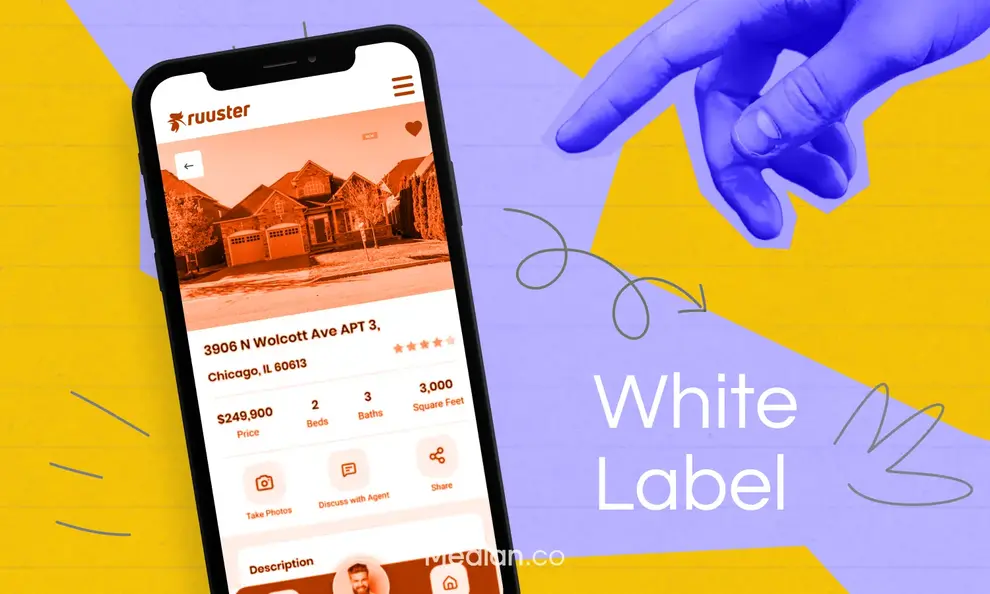
Real estate: Ruuster launches a branded app for every brokerage it signs, and turned app deployment from a fixed cost into a variable one.
What to look for in a mobile app platform
If you're converting, the platform matters as much as the price. Look for one that:
Builds native iOS and Android apps from your existing web app, with no rewrite
Lets you preview and test before you publish
Offers native features like push notifications, biometric login, and analytics as ready-made plugins
Handles App Store and Google Play submissions and keeps the app current as the rules change
Passes your security review, with a SOC 2 report and no user data routed through its servers
Offers both self-serve and managed plans, so you can start small and get help later
Get a native app without a second codebase
Median turns websites and web apps into native iOS and Android apps, then handles publishing and ongoing updates. Your team keeps working in the web app it already knows, and native features come from plugins rather than native development. Teams at McKesson, Whole Foods Market, and Aon build with Median.
Not sure which route fits your app?
Talk to our team about your web app, your timeline, and who'll own it after launch. We'll tell you which plan fits, or whether converting fits at all. Contact Sales →
App development cost FAQs
How much does it cost to make an app in 2026?
It depends on the route. AI app builders start free, with paid plans from about $16 to $25 a month. Agencies charge $5,000 to $300,000 or more, depending on complexity, and enterprise apps can pass $2 million. Building in-house costs the most over time, because you're paying developer salaries (a US median of $135,980 in May 2025) for each platform. Converting an existing web app with Median starts at $229.
How much does it cost to make an app by yourself?
If you already have a website or web app, you can convert it yourself with Median's personal plans, which start at $229 to activate and $179 a year, plus the mandatory app store fees. Building from scratch yourself costs less in cash but takes far more time.
How much does it cost to put an app on the App Store and Google Play?
Apple charges $99 a year for its developer program, and Google charges a one-time $25 for a Play Console account. Those fees are the same, however you build the app.
Is converting a website into an app cheaper than building a native app?
Yes, in most cases. Converting reuses the web app you already have, so you skip hiring iOS and Android developers and maintaining separate codebases.
How much does it cost to maintain an app every year?
Expect roughly 15% to 25% of the original build cost each year, based on industry estimates. That covers platform updates, hosting, third-party services, and fixes, plus Apple's $99 annual fee.
Can I build an app for free?
You can build a basic web app for free on most vibe coding tools, including Lovable, Bolt, and Base44, within their free plan limits. Publishing it as a mobile app isn't free. Apple charges $99 a year, Google charges a one-time $25, and you'll need a way to package it as a native app.
*DISCLAIMER: This content is provided solely for informational purposes. It is not exhaustive and may not be relevant for your requirements. While we have obtained and compiled this information from sources we believe to be reliable, we cannot and do not guarantee its accuracy. This content is not to be considered professional advice and does not form a professional relationship of any kind between you and GoNative.io LLC or its affiliates. Median.co is the industry-leading end-to-end solution for developing, publishing, and maintaining native mobile apps for iOS and Android powered by web content. When considering any technology vendor we recommend that you conduct detailed research and "read the fine print" before using their services.*